
Fibre optic links for companies and development projects: design, pulling, splicing and testing
Fibre links for companies and developers: route design, pulling fibre, splicing, outdoor routes, PV, racks and fibre testing.
In this article
- Why companies and developers increasingly care about fibre
- Fibre in buildings: backbone for offices, CCTV, Wi‑Fi and access control
- Reference from practice: fibre in ePet Arena for AC Sparta Praha
- Fibre links on outdoor sites: when distant buildings need to be connected
- Fibre for PV and energy projects: communication between technologies must be stable
Key takeaways
- ✓ A practical example of a solution in real operation
- ✓ Connected to a specific service or technology
- ✓ Suitable for companies, construction sites, campuses and public buildings
Table of contents
Next step
Request a solutionFibre optic links are no longer reserved for data centres or large telecom operators. In companies, production sites, logistics halls, development projects, schools, office buildings and photovoltaic power plants, fibre is becoming the backbone infrastructure supporting connectivity, CCTV, access control, Wi‑Fi, building technologies, energy systems and service monitoring.
At first glance, a fibre optic cable may look like “just a cable”. In practice, everything around it matters: route design, mechanical protection, cable type, spare lengths, penetrations, rack termination, fibre splicing, labelling, documentation and final fibre testing.
That is why it pays to work with a partner who does not only pull the cable, but can deliver the whole fibre link from the first proposal to handover.
At Global Elektronic, we deliver this work for companies, schools, development projects, industrial sites, energy projects and public buildings. Dozens of companies and organisations have already chosen us for fibre routes, fibre pulling and splicing, rack termination and handover with measurement.
Why companies and developers increasingly care about fibre
Companies and development projects need infrastructure that will not slow down the building in one year or in five years. Buildings are adding more CCTV cameras, access control systems, Wi‑Fi access points, energy technologies, PV, BESS, metering, monitoring systems, server rooms, racks and remote management.
Copper cabling still has its place, but for longer routes, site interconnections and backbone links, fibre is often the much better choice.
Fibre optic links make sense especially for:
- interconnecting buildings on a company or industrial site,
- connecting warehouses, halls, offices and technical rooms,
- development projects with multiple tenants or technology zones,
- CCTV points and monitoring systems over longer distances,
- backbone links between racks,
- PV, BESS and energy technologies,
- outdoor routes between buildings,
- schools, offices and public buildings,
- operations where stability, speed and future capacity matter.
A well-designed fibre optic network is not a one-time cost. It is infrastructure that can hold the whole building together for years.
Fibre in buildings: backbone for offices, CCTV, Wi‑Fi and access control
In larger buildings, one of the biggest mistakes is underestimating fibre at the design stage. The investor solves layouts, electrical installation, switchboards, HVAC and other trades — but the data backbone is sometimes left “for later”.
Later, every change becomes more expensive.
In office, production and development buildings, fibre often connects:
- the main distributor and technical rooms,
- individual floors or sections of the building,
- racks and server infrastructure,
- tenant units,
- CCTV systems,
- access control,
- Wi‑Fi infrastructure,
- reception areas, entrances, garages and technical operations.

If routes, spare capacity and rack termination are designed correctly, the building is ready for future expansion. If not, improvisation begins: added surface trunking, unclear routes, short reserves, poor labelling and service that takes far too much time.
That is why, with fibre, we always consider not only the current need, but also what the building may need in the next few years.
Reference from practice: fibre in ePet Arena for AC Sparta Praha
Fibre makes sense wherever technologies must operate quickly, reliably and without improvisation. Typical examples include sports facilities, public buildings and operations with high connectivity requirements.
For AC Sparta Praha, we participated in technical works at ePet Arena / Letná stadium and in the facilities of the Great Strahov Stadium. The scope included fibre routes, pulling fibre optic cables, fibre splicing, copper cabling and preparation of infrastructure for AXIS camera systems according to UEFA requirements.
Projects like this show why fibre is not just about pulling a cable. In important buildings, the route design, coordination with other technologies, clean termination, documentation and confidence that the link is ready for real operation are all critical.
Fibre links on outdoor sites: when distant buildings need to be connected
Company and industrial sites often need to connect buildings, gatehouses, halls, warehouses, camera points, fence technology, transformer stations, PV plants or outdoor switchboards.
This is where fibre excels: it enables stable data transmission over longer distances and creates a reliable backbone between different parts of the site.
For outdoor routes, design is crucial:
- where the cable will run,
- whether it will be in the ground, a conduit, pipe, tray or another route,
- how it will be protected against mechanical damage,
- where spare lengths will be left,
- where termination will be located,
- how the route will be serviced in the future,
- how the entire link will be documented.
Outdoor fibre leaves little room for mistakes. A poorly designed route is difficult to repair later, especially when it runs through a finished site, roads, parking areas or technology zones.
Fibre for PV and energy projects: communication between technologies must be stable
In larger PV plants, battery storage and energy projects, the system is no longer only about panels, inverters and switchboards. The data and communication layer is also essential.
Fibre can be useful for:
- connecting PV technology with the electrical room,
- data transfer for monitoring and supervision,
- communication with EMS/SCADA,
- interconnecting remote parts of the site,
- connecting CCTV systems,
- linking BESS or other energy elements,
- communication between technical buildings.
In photovoltaics and energy technologies, data infrastructure should not be treated as the last small detail. If the system is to be monitored, serviceable and ready for future expansion, fibre must be part of the overall design.
This is where a supplier with knowledge of data routes, electrical installation, switchboards, PV, security technologies and service has a clear advantage.
Fibre for development projects: a subcontractor who keeps the result together
Development projects have one major feature: many trades meet on site and every deadline affects the next one. Fibre must therefore be delivered in a way that does not slow the project and is ready for long-term use.
For developers, general contractors and implementation companies, we can deliver the fibre part as a specialist package:
- site inspection and consultation,
- route and technical design,
- coordination with other trades,
- pulling fibre optic cables,
- termination in racks or cabinets,
- fibre splicing,
- labelling and documentation,
- fibre testing and handover protocol.
This matters especially where the investor or general contractor is not looking for “someone to pull a cable”, but a subcontractor who can deliver the result from A to Z. We use the same approach in schools, public buildings and company facilities, where fibre often forms the backbone for connectivity, CCTV, Wi‑Fi, access control and other technologies.
Pulling fibre: it is not just about cable length
When pulling fibre optic cables, precision matters. Fibre is powerful, but it requires correct handling. Wrong bend radius, unsuitable pulling, mechanical stress or a poorly prepared route can create problems that appear only during testing or later operation.
During implementation, we therefore solve:
- cable type according to the environment,
- route and mechanical protection,
- spare length at both ends,
- penetrations and transitions,
- protection against damage,
- future accessibility,
- clean termination in the rack,
- labelling for administration and service.
In company buildings, halls and development projects, it is also important to remember that fibre will often serve more than one technology. Today it may be CCTV and Wi‑Fi; in a few years it may be another rack, new tenants, PV, access control or remote monitoring.
Fibre splicing: where the quality of the link is decided
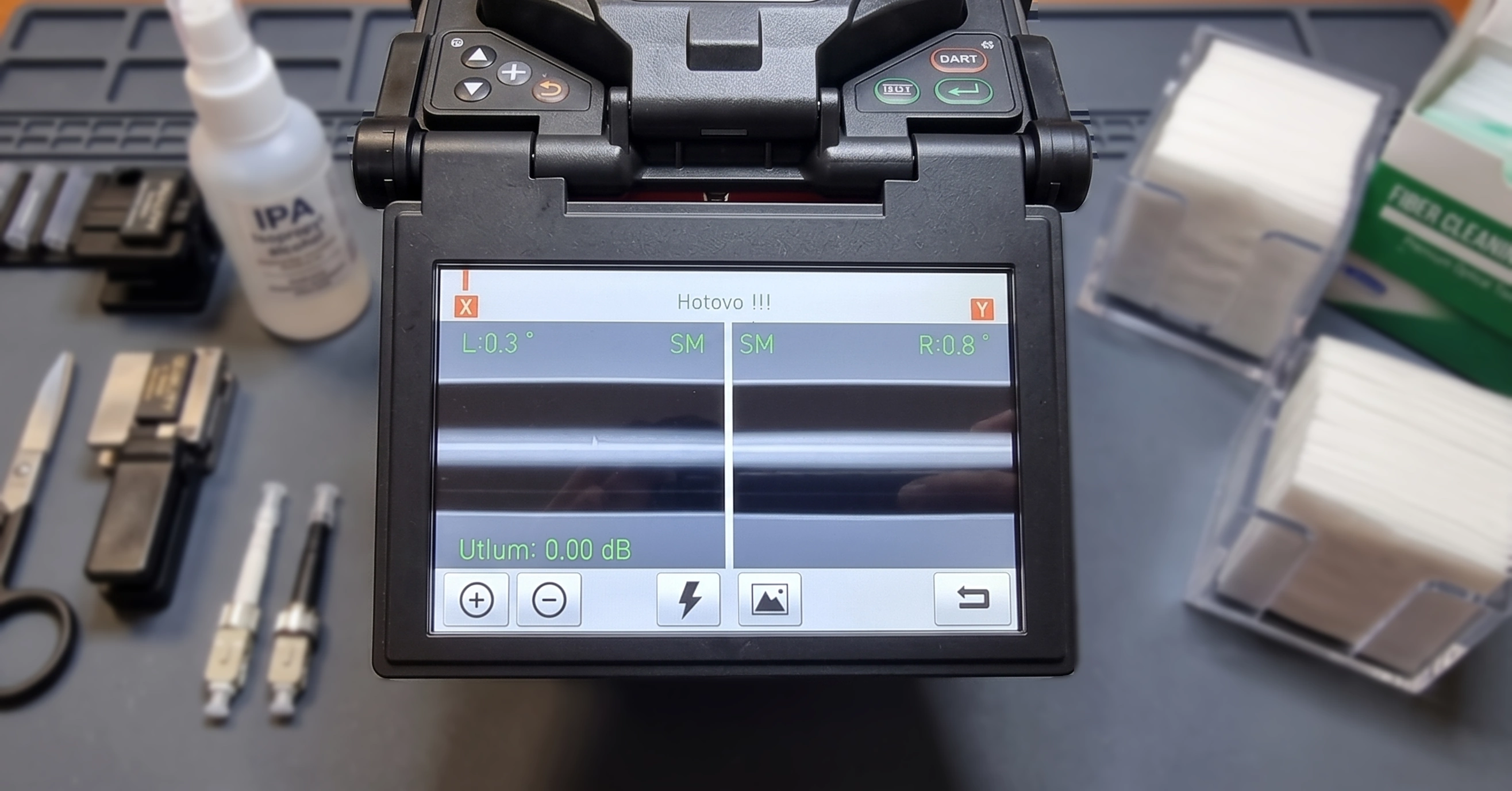
Fibre splicing is not just a technical detail at the end of a project. It is one of the key steps that affects attenuation, stability and future reliability of the whole link.
The photo shows a practical example of work with a fusion splicer showing a practically zero splice loss. In real operation, the exact values are always verified by measurement, but the principle is clear: high-quality preparation, clean work, proper splicing and final testing are essential.
A good splice depends on:
- correct stripping and preparation of fibres,
- clean handling,
- precise alignment,
- appropriate splice protection,
- correct placement in the splice tray,
- neat arrangement inside the fibre tray or rack,
- final testing of the link.
With fibre, details decide the result. A poorly made splice may look fine at first glance, but it can cause increased attenuation, instability or service complications later.
Termination in a rack: the link must be clear and serviceable
A fibre link does not end when the cable reaches the rack. Termination, labelling and arrangement are equally important.
In practice, we focus on:
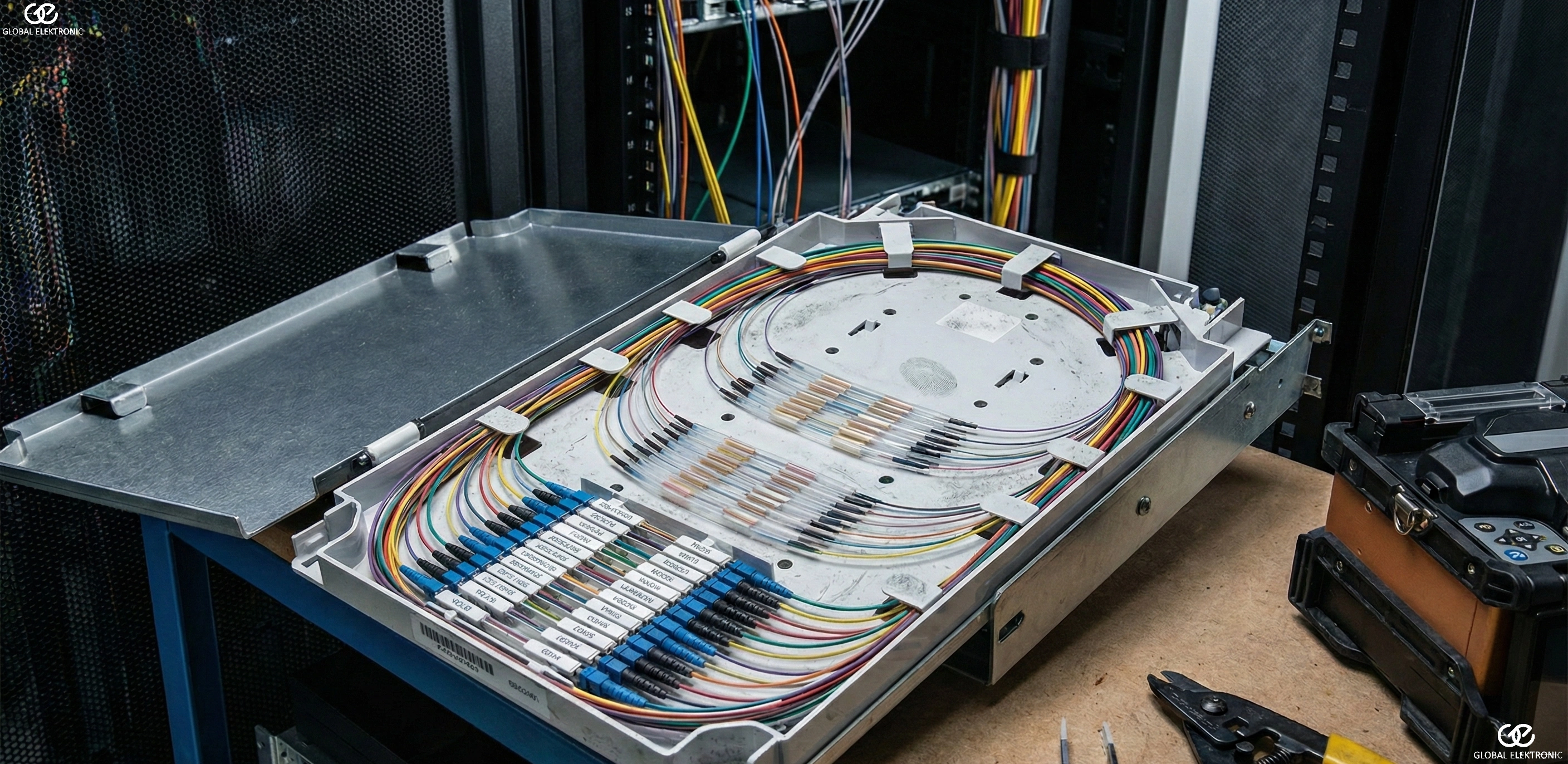
- fibre trays and splice cassettes,
- clear patch panels,
- correct patch cords,
- protection of fibre reserves,
- labelling of routes and ports,
- logical arrangement for future service,
- documentation usable for the operator.
A clean rack saves time during every future change, service intervention or expansion. This matters in schools, offices, company buildings, server rooms and development projects.
Measuring fibre: the final proof that the link is ready
A fibre optic link must be tested. Without measurement, the customer only knows that a cable has been installed — not whether the link is truly ready for reliable operation.
That is why we finish fibre projects with testing. Measurement confirms attenuation, route quality and whether the link meets the expected parameters.
Final testing is important because it:
- verifies the quality of splices and terminations,
- reveals problems before handover,
- provides a clear output for the customer,
- simplifies future service,
- creates documentation for the building operator,
- proves that the optical link is not only installed, but functional.
This is the point where the difference between “a cable in place” and a professional fibre link becomes obvious.
Fibre optics from design to tested handover
Fibre optics are often part of larger technology packages: CCTV, access control, Wi‑Fi, PV, BESS, building automation, schools, industrial sites and development projects. That is why it should not be approached as an isolated task.
At Global Elektronic, we connect fibre with structured cabling, IT infrastructure, CCTV systems, access control, PV and service.
The result is not just a cable. The result is a planned, pulled, spliced, terminated, labelled, documented and tested fibre optic link.
Are you planning fibre links for a company, school, development project, PV plant or outdoor site? Explore our fibre optic networks, structured cabling or contact us through the contact page. We will design the route, pull the cable, splice the fibres, terminate the link and finish the project with fibre measurement.
Solution consultation
Working on a similar project?
Get in touch with us. We will suggest a suitable technical solution based on the location, operation and requirements.
Related service
This article is related to Our services
If you are dealing with a similar project in practice, continue to the service detail or send us the basic project parameters.
Keep reading
Related articles

Custom switchboard for the exact building: why universal solutions are not enough
Custom switchboards for companies, homes, schools, PV and operations. Why design, production, labelling, testing and service matter.

Electrical inspections for companies, schools, apartment buildings and homes: why not wait for a fault
Electrical inspections for companies, schools, apartment buildings and homes: initial and periodic inspections, appliance testing, risks and service.
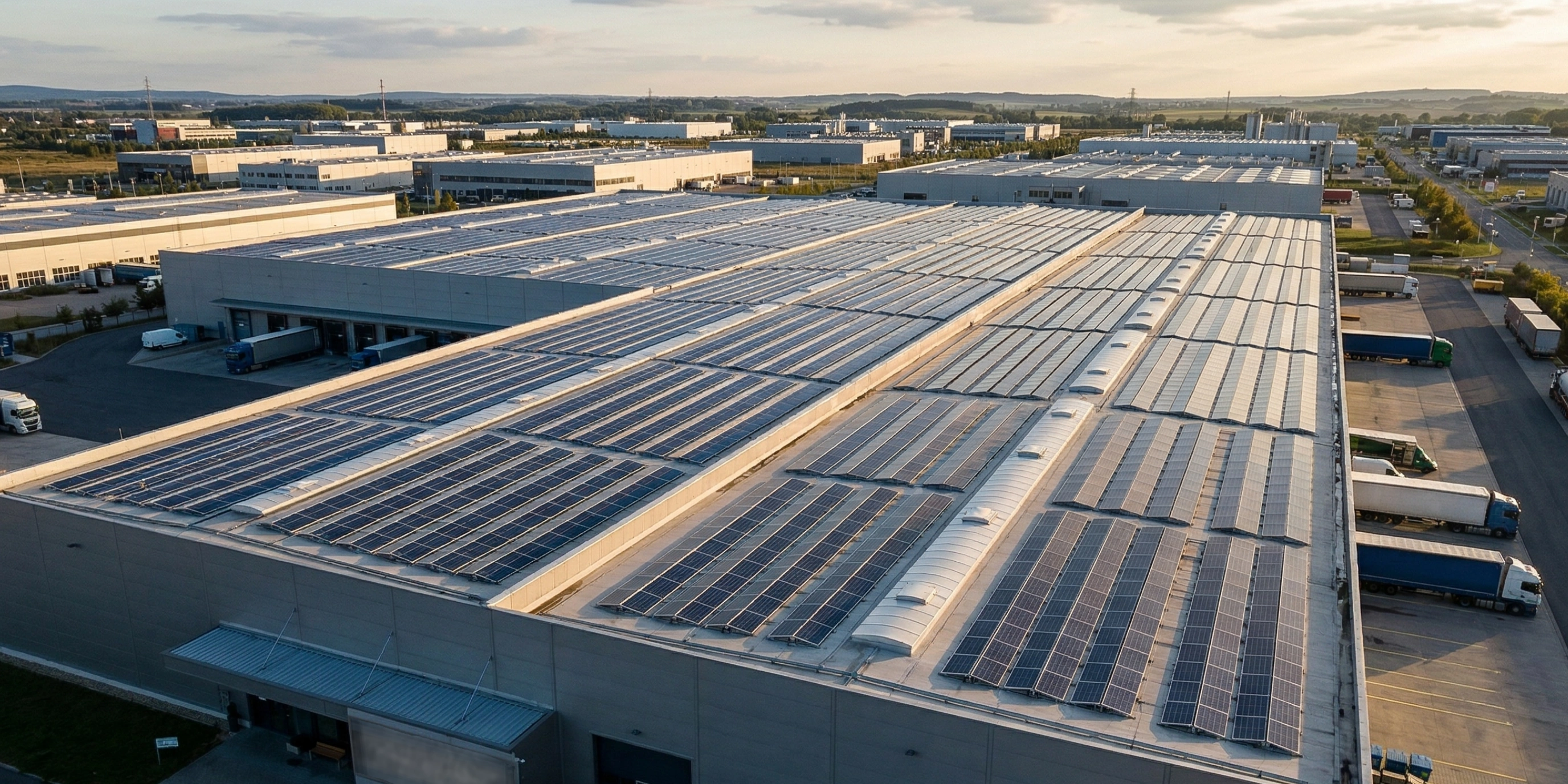
Commercial Rooftop PV: Why South Is Not Always Best
South-facing panels do not always mean the best result. In commercial rooftop PV, east-west may work better for self-consumption, EMS and BESS.
